Early-stage founders often think they have a growth problem when they actually have a prioritization problem.
The team is moving, experiments are running, and product work is shipping, but the company still cannot answer a basic question: what evidence would prove we are getting closer to product-market fit?
That is what traction is for. Traction is not a vibe. It is evidence that the market is responding to your offer in a repeatable way.
If you want the metrics-specific version of this topic, read Startup Traction Metrics.
Start with one traction definition
Before you build dashboards, define what traction means for your stage.
At an early stage, it usually looks like one of these:
- a rising percentage of users who hit your core value moment
- increasing retained revenue from the right customer segment
- repeatable demo-to-close performance
- increasing usage depth among ideal customers
The mistake is trying to track everything at once. Pick the one signal that most clearly reflects value creation.
Choose a north star that fits your business model
For a PLG product, that may be activated users or retained teams.
For a sales-led product, it may be qualified pipeline, closed-won revenue, or expansion from early customers.
For a marketplace or network product, it may be successful transactions or retained supply-demand pairs.
The point is not to sound smart. The point is to choose a metric that forces the team to focus.
Build traction through short learning cycles
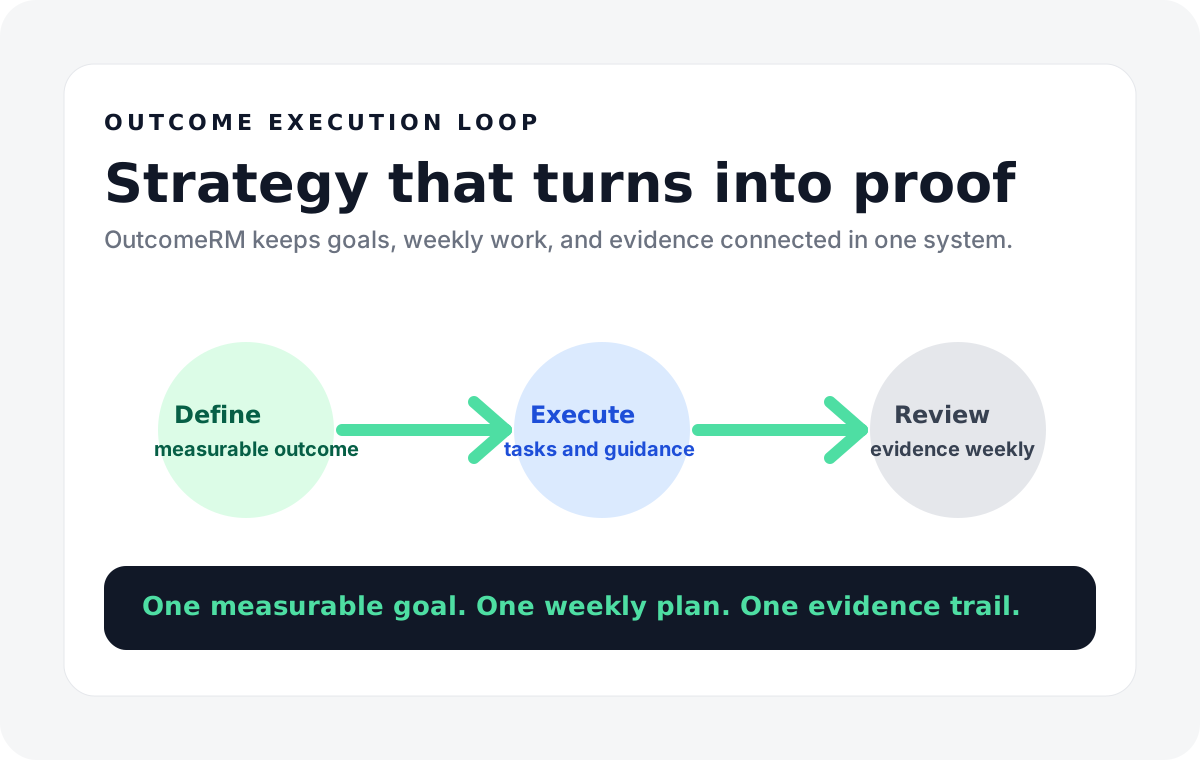
The highest-leverage founders run the company in tight loops:
- define the hypothesis
- launch the smallest viable test
- measure actual behavior
- cut what did not work
- double down on what did
That is why two-week or one-month sprint cycles work so well. They turn strategy into a sequence of measurable bets.
A simple sprint structure for founder teams
Every sprint should answer three questions:
What are we trying to move?
Example: increase activated users from 22% to 30%.
What do we believe will move it?
Example: shorten setup friction, improve onboarding copy, and add clearer in-product prompts.
How will we know fast if it is working?
Example: time to first value, activation rate by cohort, and usage depth in week one.
Without those three answers, a sprint becomes a work bucket instead of a traction engine.
Separate leading indicators from investor metrics
Investors care about outcomes such as growth rate, net revenue retention, CAC efficiency, and logo growth.
Your operating team still needs leading indicators that tell you whether the machine is improving before the board meeting arrives.
Those leading indicators might be:
- demo conversion by channel
- activation by source
- retained usage by persona
- proposal acceptance rate
- payback period by segment
The best startup operating systems connect the leading indicators to the investor-facing metrics instead of treating them as separate worlds.
Common founder mistakes that kill traction
Measuring vanity instead of value
Traffic, impressions, and signups are not worthless, but they are weak if they do not connect to retention or revenue.
Running too many experiments
More tests do not automatically increase learning. Too many parallel bets usually reduce quality and create noisy data.
Letting product and go-to-market drift apart
If the product team optimizes activation while the sales team chases the wrong accounts, traction will look inconsistent even if each team is individually busy.
The founder operating cadence that scales
A useful weekly cadence looks like this:
- Monday: review core metrics and decide the week's priorities.
- Midweek: inspect execution quality, not just output volume.
- Friday: document what worked, what failed, and what changes next week.
This sounds simple, but it creates institutional memory. Over time, that is how founders stop repeating the same expensive mistakes.
When traction is strong enough to scale
You do not need perfection. You need repeatability.
Signs you are ready to scale a channel or team:
- conversion is stable enough to forecast
- retention is strong in a defined customer segment
- onboarding and delivery are no longer founder-dependent
- your best-performing acquisition channel is producing consistent economics
Scaling too early amplifies waste. Scaling after repeatability amplifies learning.
FAQ
What is the best traction metric for a startup?
The best metric is the one that most closely reflects real customer value for your stage and business model. There is no universal answer.
How often should founders review traction?
Weekly is the minimum for operators who want fast feedback. Monthly is too slow for most early-stage teams.
What should founders do when traction stalls?
Tighten the target segment, simplify the offer, and focus the next sprint on one bottleneck instead of launching more disconnected experiments.
If you want a cleaner way to connect traction metrics to weekly execution, use OutcomeRM pricing as a starting point and structure the company around one measurable outcome at a time. For the metrics-only breakdown, also read Startup Traction Metrics.